
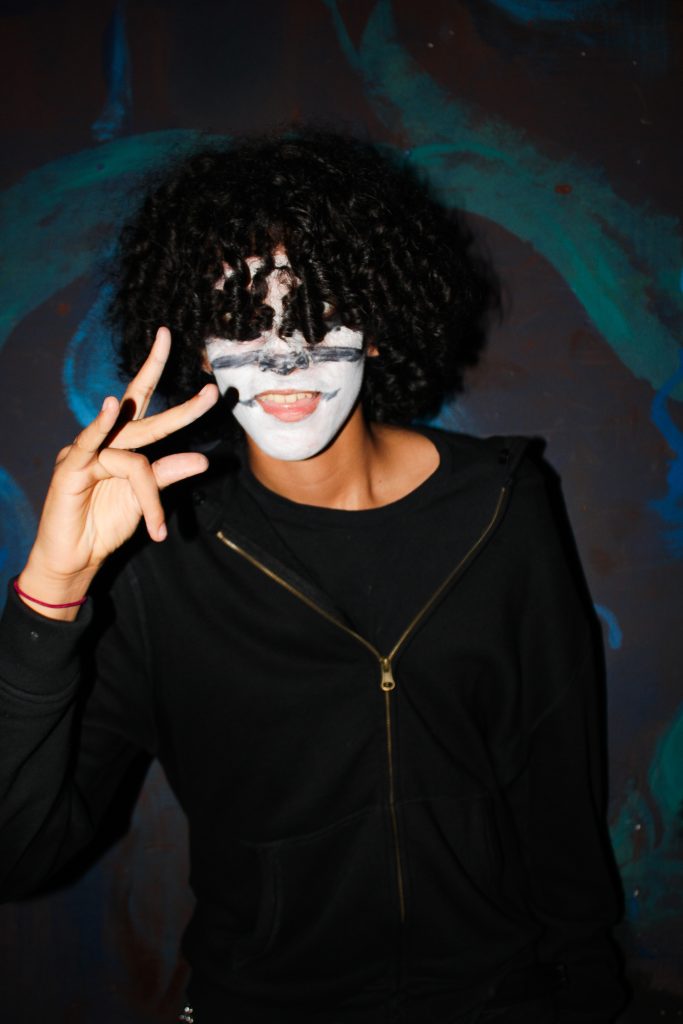
On a random Tuesday night, we decided to see Bleood for a second time during his Kill Your Idols tour stop in Houston, Texas. He previously had a show here on June 1st as part of his Protagonist tour, and now, five months later, the venue had tripled in size, the stage production had gotten more electric, and the fans were face-painted and ready to mosh.
Upon arrival, the line to get into the show was super long, and the most shocking detail of it all was how big Bleood had gotten in just five months.
Recently, there has been tons of discourse surrounding Bleood, who just released his highly anticipated album KILL YOUR IDOLS. However, the reception was largely focused on how unconventional, noise-heavy, and uncoordinated the album was. Tons of underground listeners couldn’t really get into the sound, and there was a lot of skepticism about how this music would translate live.
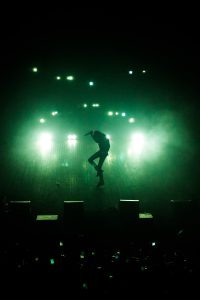
However, the set actually did Bleood’s music justice, with pulsating bass, rave-adjacent transitions, and blinding flashing lights. It’s like you might not understand the music or the lyrics, but you can feel the energy.
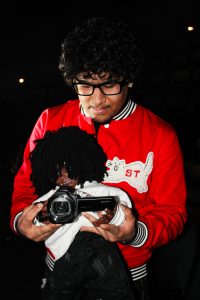
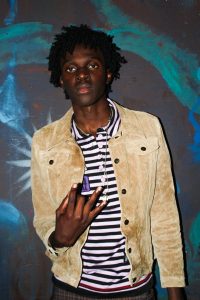
We also ran into tons of notable creatives and underground-adjacent influencers, like NoahSoCold, who was wielding a camcorder and holding the iconic Kill Your Idols doll. We also ran into Alagie, who, upon our interaction, said, “Yeah, I’m the guy who be in his backyard and sh*t.”
However, Bleood’s rapid growth also comes at a cost. One of the main downsides of the show was that it felt like 60% of the fans didn’t know any of the songs. It got to a point where they weren’t moshing as hard as they should’ve, especially compared to the previous show we attended, where the barricades literally had to be held together because of how aggressive the crowd was.
That’s honestly a problem because fans will “larp” just to be involved with the scene, even if they don’t particularly like the artist or their music.
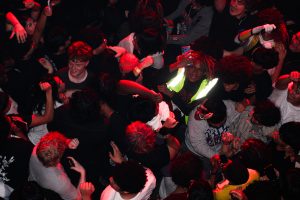
Overall, the most interesting part about the show wasn’t the noise-filled bass or getting flashbanged by the set, but the fact that music as unconventional and unstructured as Bleood’s can be performed live and moshed to. It raises a bigger question: Within the rage genre, are there really any rules? Can fans mosh to anything, regardless of how chaotic or abrasive the music gets?
Bleood’s performance suggests that maybe rage music doesn’t need structure or even conventional musicality to connect with an audience. Sometimes, all it takes is noise, energy, and a crowd willing to embrace the chaos.
By Ed Roobi